
The early childhood education landscape in the Philippines is undergoing a decisive and necessary transformation. Confronting documented learning poverty gaps identified in national assessments, educators and policymakers are rethinking how young minds build core competencies. The nation is moving away from congested preschool syllabi, shifting toward an intentional focus on foundational reading, early numeracy, and holistic community support during the critical early years.
Streamlining the early learning blueprint
The defining shift in Philippine early childhood education is the nationwide implementation of a decongested curriculum for early learners. Previous frameworks overwhelmed young children with an excessive number of competencies, often leading to superficial rote learning rather than deep cognitive mastery.
Under updated early grade guidelines, learning objectives have been reduced by up to 70 percent to prioritize essential core skills. Kindergarten programs are reaffirming the power of structured, purposeful play. Instead of memorization drills, young learners engage in interactive storytelling, oral language development, and guided exploration designed to spark genuine curiosity and foster emotional resilience before entering primary school.
Prioritizing foundational numeracy alongside literacy
While early reading initiatives have gained strong national momentum through structured phonics and literacy assessments, educators are placing renewed urgency on early mathematical reasoning. National data indicates that without a solid numerical foundation in preschool and kindergarten, math anxiety and learning deficits widen sharply in later grades.
Classrooms and child development centers are increasingly integrating hands-on manipulatives, spatial pattern games, and everyday problem-solving into the daily routine. This evolution reflects the core cognitive reality that mathematical ability is not an inherited gift reserved for a few; it is deliberately built through early, consistent exposure to logical patterns and number sense.
The transformative role of the home environment
Institutional reforms can only succeed when reinforced at home. In the Philippines, where extended families play an active role in daily upbringing, the home represents the primary classroom for early talent development.
When parents and caregivers transform daily household routines into rich learning moments—counting market fruits, practicing vocabulary through vibrant storytelling, and encouraging analytical questions—children enter formal schooling with confidence. Educational success begins long before the first school bell rings, proving that dedicated parental engagement is the ultimate catalyst for unlocking every child's full intellectual potential.
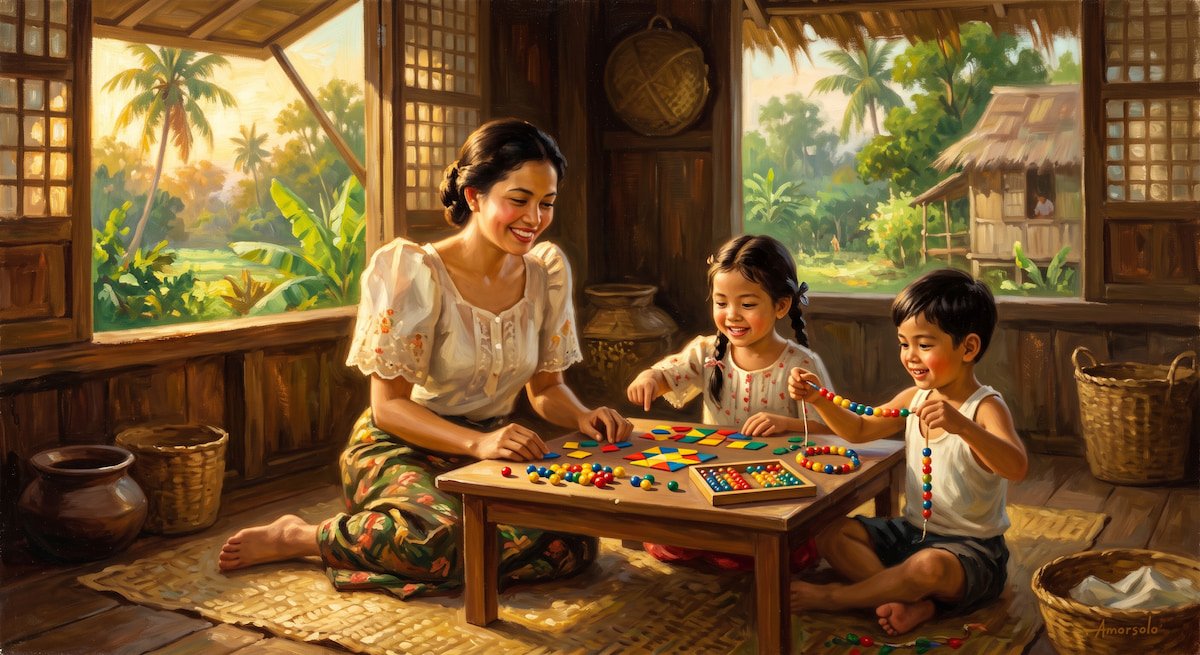
Picture: A Filipino family engaged in an early math game (ChildUp / Gemini)