
Denmark has long been celebrated as the global gold standard for child-centered, outdoor-focused early childhood education. With nearly universal participation in early daycare and kindergarten (dagtilbud), the Danish model prioritizes emotional well-being, social democracy, and independence from a very young age. Yet, as educational research evolves, Danish educators and parents are refining this classic approach—ensuring that unstructured outdoor play works hand-in-hand with intentional cognitive foundations.
Balancing free play with intentional early learning
The cornerstone of Danish early pedagogy is the social-pedagogical tradition, where free play, exploration, and peer relationships take center stage. Children spend substantial portions of their day outdoors in forest kindergartens, climbing trees, exploring coastal landscapes, and developing physical confidence.
However, recent national curriculum frameworks (styrkede pædagogiske læreplan) are placing greater emphasis on purposeful learning environments. Educators are increasingly embedding foundational language assessments, pre-literacy storytelling, and spatial math games into daily activities. Rather than introducing formal academic drilling, Danish preschools are proving that early mathematical reasoning and phonemic awareness can be integrated seamlessly into playful, hands-on exploration.
Unplugging the classroom and embracing physical agency
While many global school systems rushed to integrate digital screens into early learning, Denmark has taken a deliberate step back. Updated national guidelines have sharply curtailed screen use in early childhood centers, redirecting focus toward tangible, sensory-rich materials and real-world collaboration.
By keeping early classrooms largely screen-free, Danish educators foster sustained attention spans, deep imaginative play, and fine motor dexterity. Children learn persistence through building physical structures, navigating social compromises with peers, and taking calculated physical risks in nature. This approach reinforces a core developmental truth: resilient problem-solving and executive function are built through active physical interaction with the world, not passive digital consumption.
Cultivating academic confidence at home
Denmark’s egalitarian early learning centers excel at developing self-reliant, socially confident children. However, institutional settings designed around group dynamics cannot fully replace the personalized intellectual stimulation that occurs within the family.
The home environment remains the most vital setting for transforming natural curiosity into lasting academic talent. When parents engage their children in structured conversations, explore patterns and number games during dinner preparation, and foster a love for books, they build an extraordinary cognitive bridge. Talent is not an innate genetic blessing; it is purposefully cultivated through consistent, affectionate, and mentally engaging routines established by parents at home.
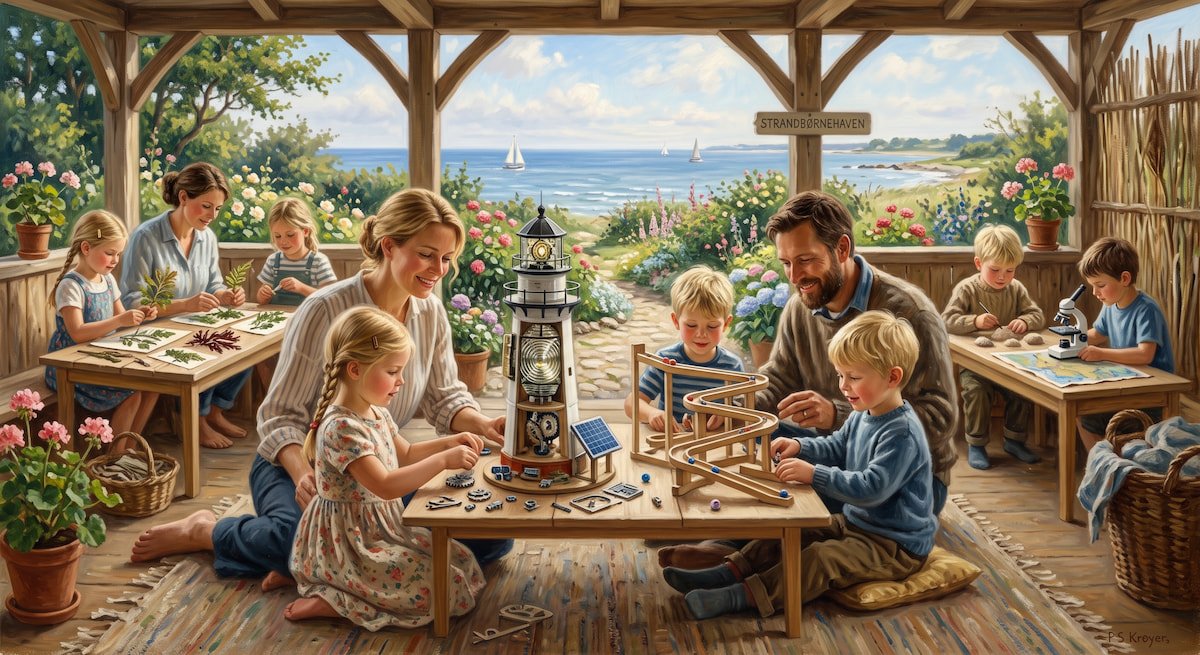
Picture: Hands-on discovery and coastal play in Danish early childhood education (ChildUp - Gemini)