
Ask almost any parent what screens are doing to their children's brains, and you will likely hear the same worried answers: shortening attention spans, limiting learning, and dulling young minds. For years, the prevailing advice has been to treat screen time as inherently harmful. But is this actually true?
A groundbreaking study from Finland is turning this widespread anxiety completely upside down, demonstrating once again that when it comes to early learning, it is the quality of the engagement that matters, not merely the medium.
The study that changed the narrative
In a comprehensive eight-year study published in August 2026 in the journal Pediatric Exercise Science, a team of Finnish researchers tracked hundreds of children from primary school through their mid-teens. The researchers began with a common assumption: more screen time equals more sedentary behavior, which should logically lead to weaker cognitive development and poorer school performance.
Instead, they observed the exact opposite.
The teenagers who had accumulated the most screen time from childhood onward actually demonstrated better cognitive processing, enhanced learning, and stronger working memory. The study's lead author acknowledged that this positive link between screen time and cognitive performance came as a complete surprise, running directly counter to the initial hypothesis the eight-year study was designed to test.
Why did this happen?
The researchers concluded that the issue was never simply "how many hours" a child spends with a device, but rather what fills those hours.
There is a vast difference between a child passively consuming an endless, auto-playing video feed and one using a screen to solve puzzles, build virtual worlds, or practice math. When children are actively engaged in thinking, problem-solving, and creative exploration, digital screens serve as powerful cognitive catalysts.
Talent is made, not born
Early academic support is crucial for long-term success, and strong cognitive skills do not appear out of thin air. They are deliberately cultivated through consistent practice, encouragement, and intentional tools.
This Finnish research aligns seamlessly with the ChildUp philosophy: technology, when utilized purposefully, is an exceptional asset for building a solid educational foundation.
The takeaway for parents
The reflexive fear that screens automatically impair a child's intellect is simply not supported by the evidence. While physical exercise and outdoor play remain indispensable for overall well-being, parents do not need to view digital devices as inherently destructive.
Instead of imposing outright screen bans, the focus should be on guiding children toward high-quality, interactive use. When curious young minds are paired with thoughtful tools—such as educational games that demand active problem-solving—the developmental outcomes can be remarkably strong.
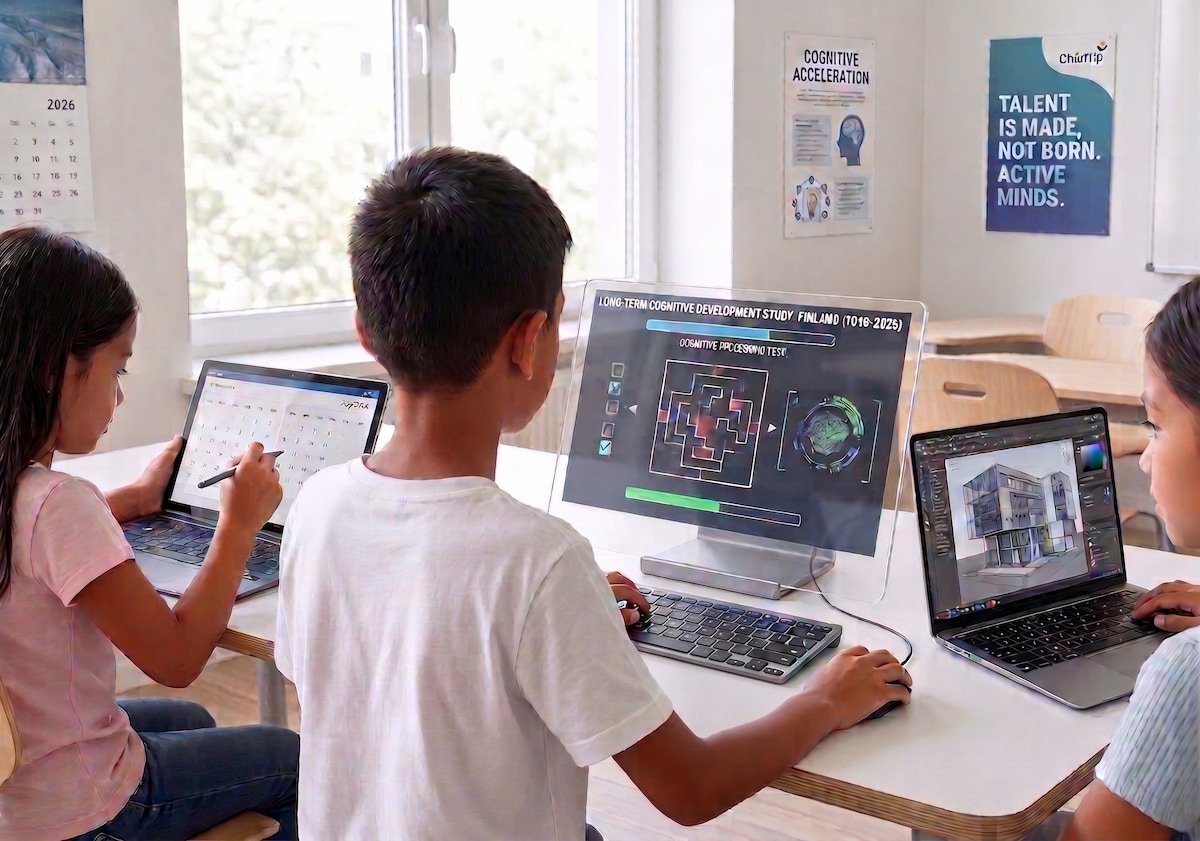
Picture: Engaging young minds through interactive learning and active screen time (ChildUp - Gemini)