Taiwan stands at the forefront of global technological innovation and educational achievement. Governed by the national Early Childhood Education and Care (ECEC) Curriculum Framework, Taiwan’s approach to early learning rejects both passive screen exposure and premature rote memorization. Instead, it weaves holistic child-centered inquiry with a deep cultural respect for concentration, persistence, and practical problem-solving. By integrating hands-on physical sciences, spatial geometry, and collaborative experimentation into everyday play, the Taiwanese model demonstrates how concrete exploration builds the cognitive architecture required for sophisticated analytical mastery.
The ECEC Framework: inquiry, self-regulation, and holistic logic
Taiwan’s national early learning curriculum is structured around core developmental domains designed to cultivate well-rounded, resilient learners: physical motor health, cognitive reasoning, language expression, social interaction, emotional regulation, and aesthetic creation.
Rather than fragmenting knowledge into isolated academic drills, Taiwanese preschools emphasize integrated inquiry. Children explore multi-step challenges that require sustained attention, systematic testing, and collaborative reflection. Through structured daily routines and guided physical coordination, educators foster exceptional executive function, self-control, and emotional maturity. This balanced socio-emotional foundation provides young minds with the psychological discipline and mental stamina needed to embrace demanding abstract concepts in later schooling.
Tangible STEM, spatial geometry, and early computational logic
Reflecting Taiwan’s technological leadership, early STEM education is rooted in physical cause-and-effect rather than digital apps. Early mathematical and scientific literacy is treated as an active, tactile discipline.
Children explore balance and structural physics through complex wooden building modules, analyze geometric symmetry with traditional puzzle structures, and discover early computational thinking through unplugged algorithmic mazes and sequencing games. Hands-on experimentation with weights, gear mechanisms, and light refraction transforms abstract principles into concrete experiences. By anchoring early science and numeracy in physical manipulation, Taiwanese educators develop intuitive spatial reasoning and scientific deduction, creating a frictionless transition to advanced mathematics and engineering.
The family as the ultimate cognitive laboratory
While Taiwan’s preschool network offers an exceptionally rich environment for collaborative inquiry and social development, group settings cannot substitute for the focused, one-on-one intellectual mentorship that happens inside the home.
Scholastic brilliance and conceptual agility are forged within the family. When parents actively step into the role of primary cognitive mentors—turning everyday mechanics into collaborative scientific investigations, exploring mathematical relationships through tangible games, and engaging in rich, vocabulary-dense dialogue—they dramatically accelerate their child's intellectual development. Enduring academic capability is never an accidental genetic gift; it is deliberately built by parents who intentionally nurture their child's cognitive foundation through loving, structured mentorship.
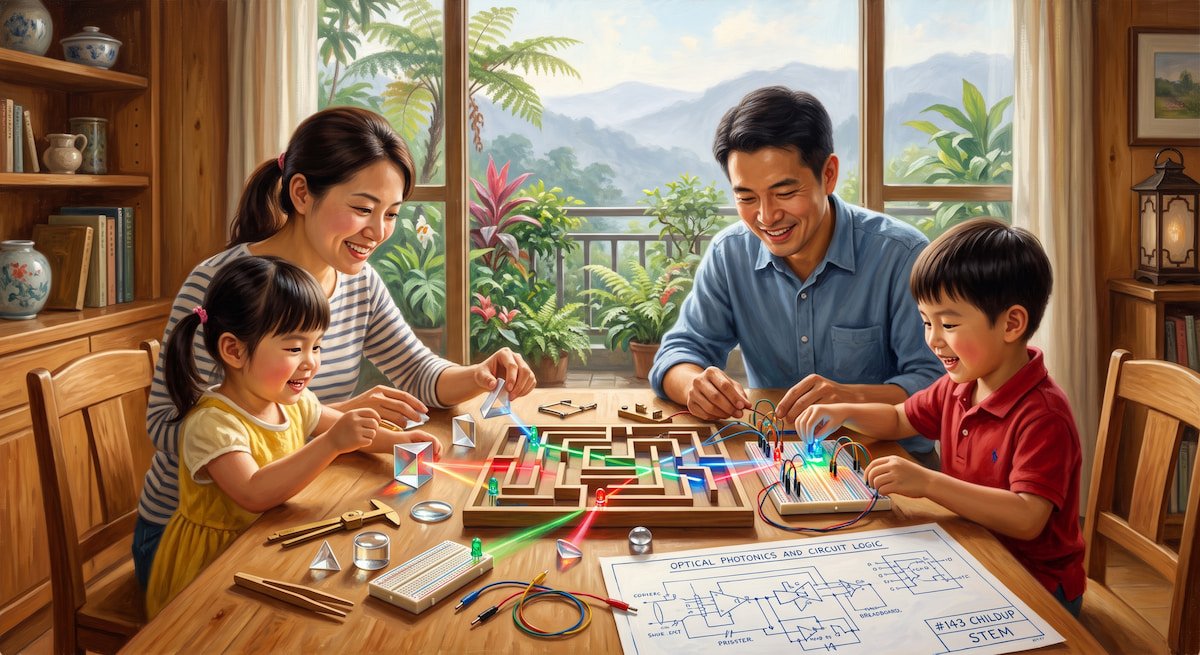
Picture: A Taiwanese family exploring optical photonics and circuit logic (ChildUp - Gemini)