Belgium features one of the most comprehensive and deeply integrated early childhood education systems in the world. With universal, state-funded preschool welcoming children as early as two and a half years old, Belgium achieves near-total participation well before the compulsory school age. Rather than viewing preschool merely as childcare, the Belgian model approaches the kleuterschool or école maternelle as a vital cognitive, motor, and social foundation. By combining structured physical orientation with precise fine-motor preparation and early spatial logic, Belgium demonstrates how early bodily and conceptual mastery prepares young minds for advanced academic achievement.
Psychomotor integration and foundational graphic precision
A central pillar of Belgian early education is psychomotricité (psychomotor education). Belgian pedagogy recognizes that high-level cognitive processes—such as abstract reasoning, concentration, and reading comprehension—are deeply rooted in physical coordination, balance, and spatial orientation.
From the earliest age, children engage in structured movement exercises designed to cross the body's midline, refine bilateral coordination, and establish clear directional awareness (left-to-right, top-to-bottom). This somatic foundation transitions seamlessly into early graphic motor training (le graphisme / voorbereidend schrijven). Through deliberate, multi-sensory tracing, continuous rhythmic curves, and geometric pattern drawing, Belgian educators cultivate hand-eye precision, finger strength, and spatial discipline without premature pencil strain or rote handwriting drilling.
Spatial geometry and multilingual awareness
Operating at the cultural and linguistic crossroads of Europe, Belgian early childhood pedagogy places significant emphasis on perceptual flexibility and structural reasoning.
Early mathematics is introduced through tangible architectural and spatial exploration. Children analyze balance, load distribution, and dimensional relationships by constructing complex structures with wooden geometric solids, arches, and interlocking modules. Simultaneously, the coexistence of Dutch, French, and German across the country fosters an early educational sensitivity to phonological distinction and verbal precision. Children are immersed in vocabulary-rich environments where narrative storytelling, descriptive dialogue, and phonemic games train the brain's linguistic plasticity for future bilingual and analytical learning.
The family as the ultimate cognitive laboratory
While Belgium’s universal preschool network provides a robust, egalitarian environment for motor development and early socialization, group classrooms cannot replicate the intensive, one-on-one intellectual mentorship possible inside the home.
Exceptional scholastic ability and creative problem-solving are built through intentional family guidance. When parents act as primary cognitive mentors—transforming daily routines into analytical investigations, exploring structural engineering puzzles, and modeling sophisticated dialogue—they accelerate their child's intellectual confidence far beyond standard benchmarks. Enduring academic capability is never an accidental genetic gift; it is deliberately and thoughtfully constructed by parents who cultivate their child's cognitive foundation through structured, loving mentorship.
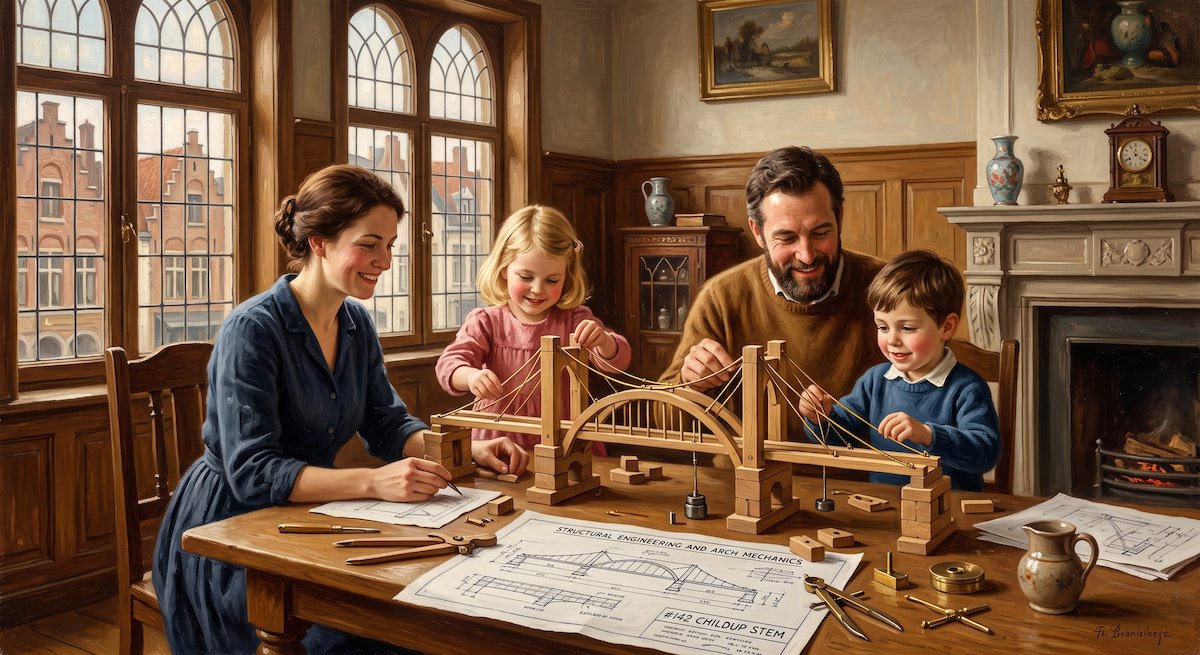
Picture: A Belgian family exploring civil engineering and bridge mechanics (ChildUp - Gemini)