Situated in a dynamic volcanic landscape beneath the Arctic Circle, Iceland has developed one of the world's most progressive and egalitarian early learning systems. Operating under the Leikskóli (playschool) framework, early childhood education is recognized as the foundational first level of the national education system. Rather than rushing toddlers into passive digital literacy or sedentary academic worksheets, Iceland champions radical outdoor resilience, open-ended physical exploration, and emotional autonomy. By treating nature as an active workshop, the Icelandic approach shows how grounding children in physical cause-and-effect constructs extraordinary cognitive grit and analytical flexibility.
The Hjalli philosophy: minimalism, raw materials, and outdoor grit
A defining pillar of Icelandic early education is the widespread influence of Hjallastefnan (the Hjalli model), created by pioneer Margrét Pála Ólafsdóttir. This philosophy strips away commercial, battery-powered, and pre-fabricated plastic toys, replacing them with simple, natural elements: untreated wood blocks, wool, sand, water, and volcanic stones.
By removing prescriptive toys, children are challenged to invent their own cognitive tools, building divergent problem-solving skills, spatial reasoning, and sustained focus. Daily life in an Icelandic leikskóli is defined by sub-Arctic outdoor immersion regardless of wind, frost, or snow. Navigating uneven lava fields and rugged outdoor terrains develops vestibular balance, risk competence, and robust emotional regulation—neurological cornerstones that cultivate long-term academic endurance.
Tactile earth sciences and geothermal mechanics
Iceland’s unique geological reality makes it a living laboratory for early STEM inquiry. Early scientific literacy is rooted in direct, hands-on observation of physical phenomena rather than virtual screen apps.
Children explore thermodynamics by observing geothermal steam vents, test crystallization and mineral density with volcanic basalt and obsidian, and study fluid dynamics in glacial runoff streams. Mechanical and physical concepts—such as heat transfer, mass, structural stability, and kinetic movement—are experienced directly through physical matter. This tangible foundation instills an intuitive grasp of the physical sciences, preparing children to comprehend advanced abstract mathematics and engineering concepts later in their education.
The family as the primary cognitive laboratory
While Icelandic leikskólar provide an unmatched framework for social equality, physical grit, and collaborative discovery, institutional environments cannot replace the focused, one-on-one intellectual mentorship that happens inside the home.
High-level analytical agility and lasting scholastic excellence are cultivated through active family engagement. When parents step into the role of dedicated cognitive mentors—turning domestic life into an ongoing scientific exploration, dissecting physical mechanics together, and engaging in rich, vocabulary-dense inquiry—they accelerate their child's intellectual trajectory far ahead of baseline expectations. Enduring academic capability is never an accidental genetic gift; it is deliberately built by parents who intentionally construct their child's cognitive foundation through loving, structured guidance.
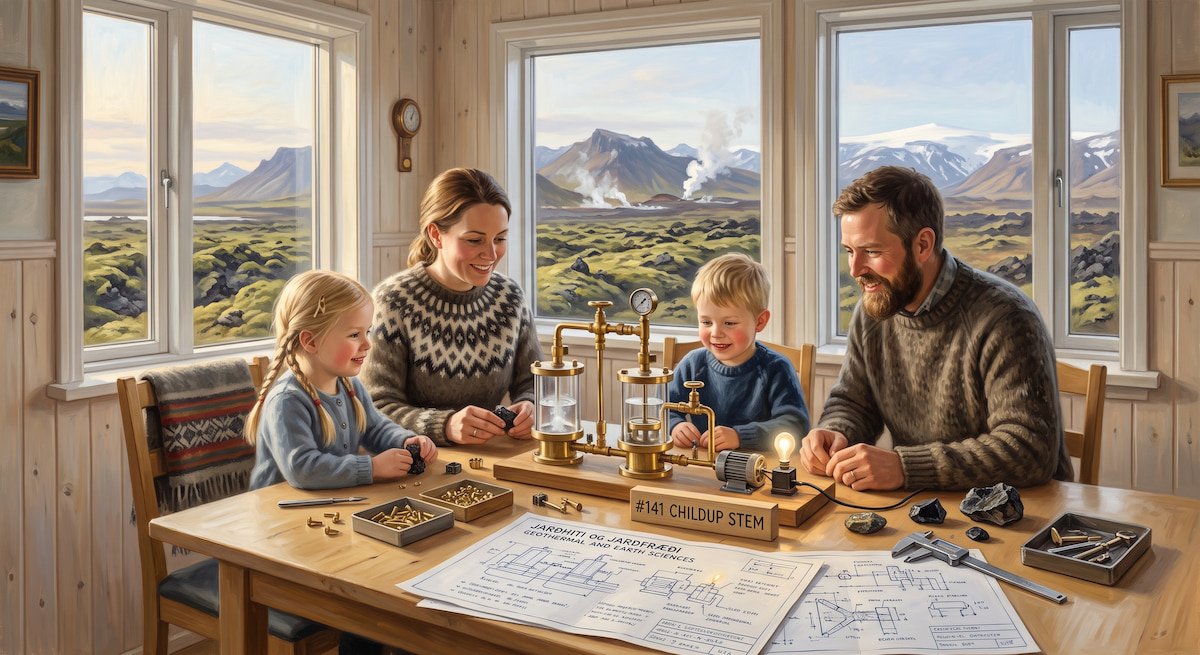
Picture: An Icelandic family exploring geothermal energy and earth sciences (ChildUp - Gemini)