Israel’s early childhood education system operates at the intersection of deep-rooted cultural traditions of inquiry and world-leading technological innovation. Guided by national kindergarten frameworks (Ganim), Israeli early education avoids passive screen consumption and rote memorization. Instead, it treats early childhood as a testing ground for curiosity, intellectual courage, and collaborative problem-solving. By cultivating independent reasoning alongside hands-on physical science, the Israeli approach demonstrates how encouraging children to question, test, and adapt constructs the underlying cognitive stamina required for future scientific leadership.
Intellectual fearlessness and constructive problem-solving
A defining characteristic of Israeli early education is the deliberate encouragement of inquisitiveness and debate. Rather than enforcing passive obedience, Israeli ganim fosters an environment where children are encouraged to challenge assumptions, articulate independent hypotheses, and treat unexpected failures as natural data points in the learning process.
This cultural emphasis on constructive initiative and resourcefulness (tushiya) develops exceptional executive function and cognitive flexibility. Children participate in daily multi-step group challenges that require dynamic negotiation, rapid trial-and-error, and emotional resilience. By normalizing complex open-ended problems early, Israeli pedagogy removes the fear of academic difficulty, instilling a persistent, solution-oriented mindset that endures throughout formal schooling.
Tactile fluid dynamics and hydro-agricultural STEM
Reflecting Israel’s pioneering legacy in water reclamation and arid-land agriculture, early scientific exploration is grounded in tangible physical mechanics and conservation physics.
Rather than relying on abstract simulations, preschool environments integrate direct physical cause-and-effect. Children experiment with fluid dynamics, hydrostatic pressure, and capillary action using transparent tubing, gravity-fed siphons, and scaled micro-irrigation systems. Concepts of volume, flow rate, gravitational equilibrium, and botanical biology are learned through tactile manipulation. This direct physical engagement anchors abstract mathematical and physical laws into concrete intuition, providing an indispensable cognitive framework for advanced engineering, calculus, and scientific reasoning later in life.
The family as the ultimate cognitive laboratory
While Israel’s public kindergartens provide an exceptional setting for social debate, adaptive thinking, and collaborative discovery, institutional environments cannot replicate the intensive, individualized intellectual mentorship that happens inside the home.
Exceptional scholastic capability and analytical clarity are cultivated within the family. When parents step into the role of primary cognitive mentors—turning domestic daily routines into spirited analytical discussions, exploring mechanical physics through hands-on projects, and modeling rigorous, vocabulary-dense inquiry—they accelerate their child's intellectual trajectory far ahead of baseline expectations. Enduring academic talent is never an accidental genetic gift; it is deliberately built by parents who intentionally construct their child's cognitive foundation through loving, structured mentorship.
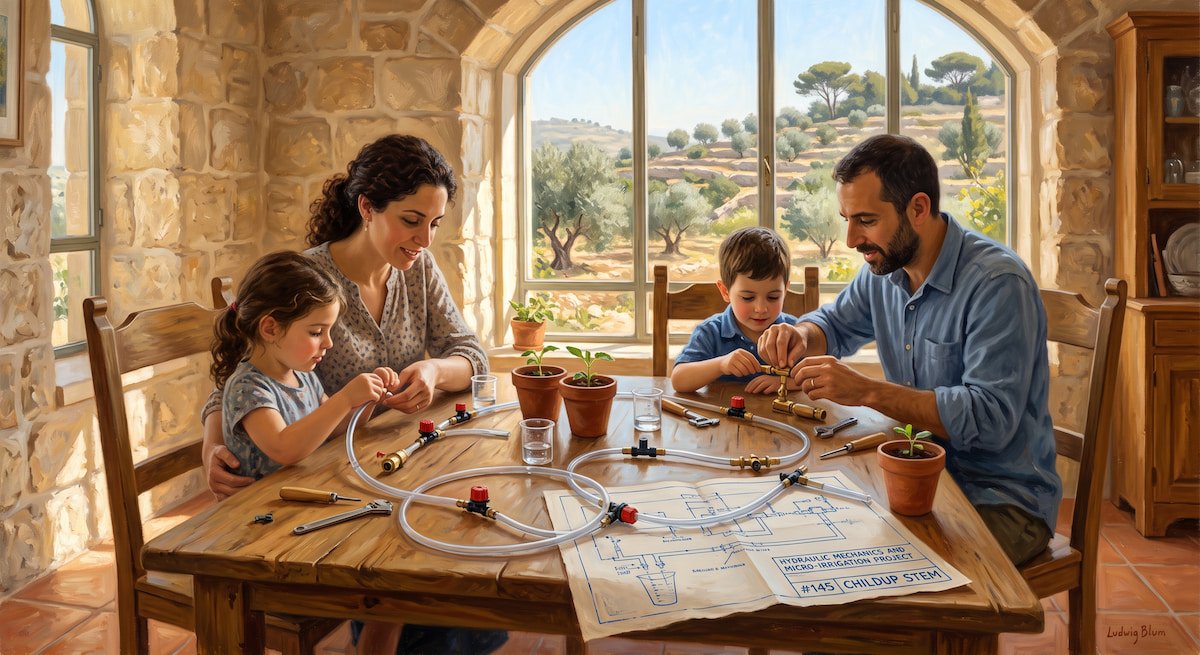
Picture: An Israeli family exploring hydro-mechanics and micro-irrigation (ChildUp - Gemini)