Austria maintains a highly refined and holistic early education framework that reflects its rich cultural heritage and commitment to social wellness. Guided by national curriculum guidelines and overseen by federal authorities, Austrian early learning prioritizes the cultivation of the whole child—cognitive, physical, and socio-emotional—over prescriptive academic drilling. Through a combination of immersive naturalism (Waldpädagogik), deeply integrated musicality, and a focus on secure relationship building, the Austrian model illustrates how structured emotional security and rich sensory exploration build the underlying neurological stamina required for lasting academic resilience.
Beziehungsgestützte Pädagogik: relationships and social stamina
At the core of the Austrian approach is Beziehungsgestützte Pädagogik (Relationship-based Pedagogy). Recognizing that cognitive development is dependent on emotional stability, Austrian educators focus on establishing high-quality, continuous interactions.
This model champions structured transition pedagogy (Transitionspädagogik), which deliberately prepares children for formal schooling starting at age six. Children are taught to navigate complex social collaborative challenges, resolve conflict constructively, and develop robust self-regulation skills (Selbstkompetenz) long before they master sedentary text comprehension. This deep investment in foundational social stamina and socio-emotional security builds the executive function protection needed for complex, multi-step critical thinking.
Acoustic physics, musical geometry, and Waldpädagogik
Reflecting Austria’s profound musical and Alpine traditions, early cognitive training is anchored in physical exploration and sensory integration.
Rather than approaching music as passive entertainment, Austrian pedagogy treats sound, acoustics, and rhythm as practical gateways to early physics and spatial geometry. Children explore thermodynamics and fluid dynamics through immersive Waldkindergarten (Forest Kindergartens), testing material density and structural physics with raw Alpine timber and mountain stones. Tactile scientific literacy is cultivated by experimenting with vibration, frequency, and acoustic resonance using real instruments and specialized tuning apparatus. By grounding early STEM learning in tangible physical phenomena, Austrian educators nurture an intuitive, concrete grasp of physical mechanics.
The family as the ultimate cognitive laboratory
While Austria’s public kindergartens provide an exceptional foundation for social democracy, nature resilience, and creative exploration, institutional settings cannot provide the specific, one-on-one intellectual mentorship that takes place within the home.
High-level analytical confidence and creative brilliance are carefully forged within the family. When parents step into the role of dedicated cognitive mentors—transforming everyday acoustic phenomena into shared scientific investigations, exploring spatial and numerical relationships, and engaging in rich, vocabulary-dense dialogue—they dramatically accelerate their child's intellectual trajectory far ahead of baseline expectations. Enduring scholastic talent is never an accidental genetic gift; it is deliberately and thoughtfully constructed by parents who intentionally nurture their child's cognitive foundation through structured, loving mentorship.
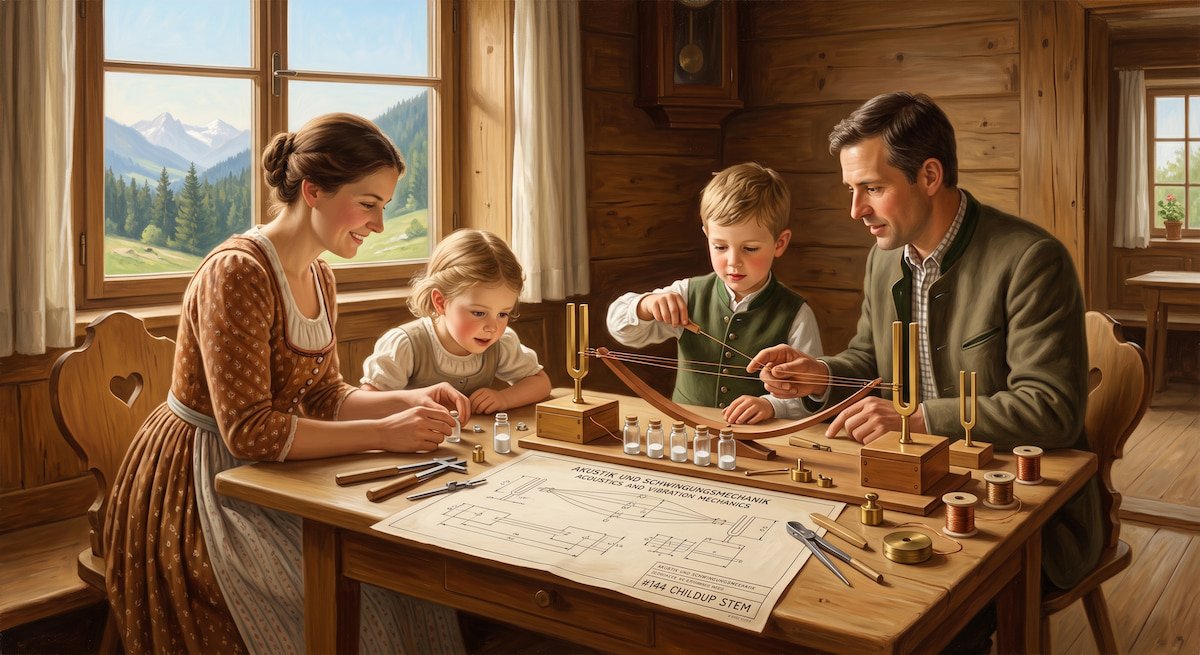
Picture: An Austrian family exploring acoustic physics and sound mechanics (ChildUp - Gemini)