France possesses one of the most structured and universally accessible early childhood education systems in the world. By legally establishing compulsory schooling from age three, the French école maternelle is not treated as optional daycare, but as an essential, public foundation of intellectual and civic life. Today, French education is undergoing a deliberate refinement—sharpening its pedagogical focus on early language precision and structured mathematics while taking a resolute stance against digital screen exposure in early childhood.
Re-anchoring the foundation in syntax and numbers
The defining development across French preschools is the implementation of updated curriculum guidelines for the cycle des apprentissages premiers (ages three to five). In response to national assessments highlighting early literacy and numeracy divides, the curriculum places structured, intentional instruction at the center of the preschool day.
Rather than relying purely on open-ended play, teachers are incorporating explicit vocabulary enrichment, complex sentence modeling, and phonemic awareness exercises into daily routines. In early mathematics, the focus has shifted toward building concrete numerical intuition: understanding quantities, manipulating geometric forms, and recognizing logical sequences. This approach recognizes that mathematical fluency is not an accidental milestone, but a skill cultivated through deliberate, daily conceptual engagement.
Safeguarding attention spans from digital distraction
While many international systems have experimented with tablets and digital apps in early classrooms, France has chosen a decisively conservative path. Grounded in national expert health and education reports, early years policy strictly limits digital screens, prioritizing hands-on, tactile exploration and direct human interaction.
In French classrooms, learning is tactile, verbal, and physical. Children develop fine motor control through traditional cursive pre-writing exercises, manipulate real physical objects to understand spatial geometry, and build social resilience through collective classroom discussions. By protecting young attention spans from digital overstimulation, educators foster the sustained focus and deep cognitive absorption required for higher-order problem-solving.
The family as the primary intellectual workshop
The French public school framework provides an exceptional standard of early socialization and foundational instruction. However, institutional schooling operates within large group ratios, meaning it cannot replicate the tailored, one-on-one intellectual stimulation possible within the family.
The most agile, confident young learners are forged at home. High-level academic capability is not an inherited trait reserved for a select few; it is systematically built when parents turn daily life into an engaging learning laboratory. When French parents engage their children in rich linguistic debates, explore early scientific principles, and play complex pattern-recognition games, they accelerate their child's intellectual trajectory years beyond baseline expectations. Genuine brilliance begins at home, driven by parents who embrace their vital role as cognitive mentors.
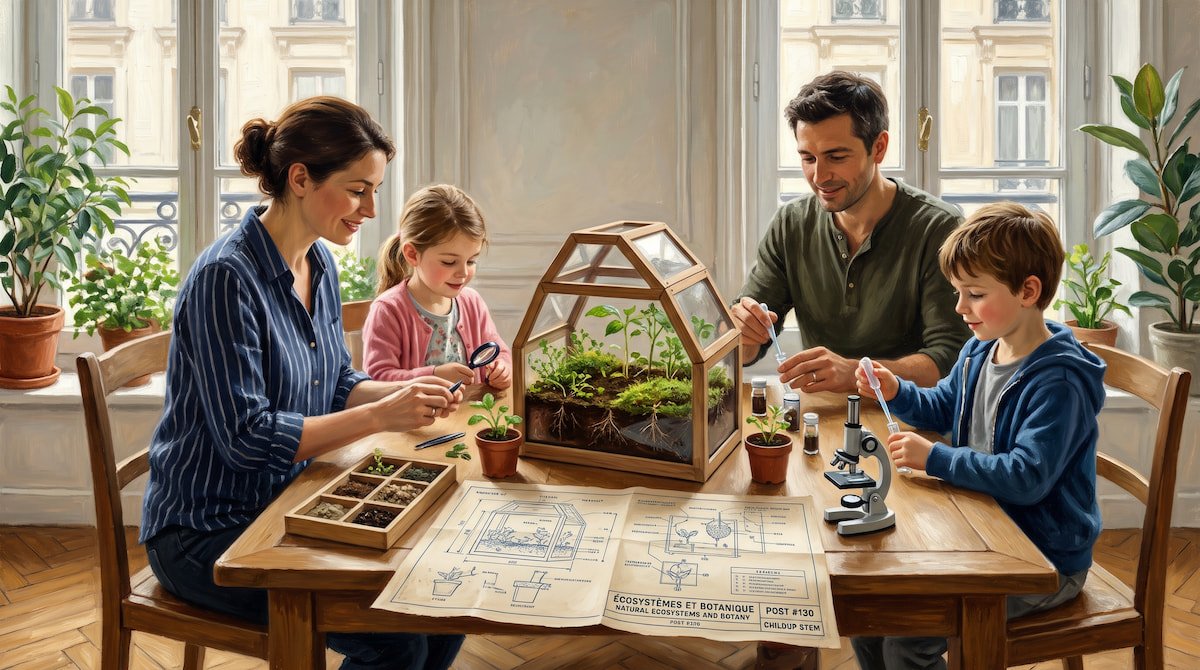
Picture: A French family exploring botanical ecosystems and plant biology (ChildUp - Gemini)