Italy holds a profound and unique place in the history of global pedagogy, having birthed two of the world's most influential early childhood frameworks: the Montessori method and the Reggio Emilia approach. Rather than viewing early education as a time for passive babysitting or rigid academic drilling, the Italian model respects the young child as a highly capable, autonomous researcher. Today, Italian early education continues to demonstrate how beautifully designed environments, tactile materials, and respectful adult observation can unlock advanced logical and creative reasoning well before formal primary school begins.
Tactile logic and structured independence: the Montessori legacy
At the heart of the Italian pedagogical tradition is Dr. Maria Montessori's revolutionary understanding that early cognition is built through the hands. In Italian scuole dell'infanzia, children are often guided through a meticulously sequenced curriculum of physical materials.
Early mathematics and geometric reasoning are never taught through abstract memorization. Instead, children manipulate concrete "sensorial" materials—such as the iconic Pink Tower for volume and spatial scaling, or golden bead materials for the decimal system and early arithmetic. By isolating specific scientific and logical concepts into tactile puzzles, the Italian approach allows children to develop deep concentration, fine motor precision, and an intuitive, concrete grasp of complex mathematical architecture.
The environment as the third teacher and phenomenon-based inquiry
Complementing structured tactile logic is the Reggio Emilia philosophy, which views the child as possessing "a hundred languages" (i cento linguaggi) through which to construct meaning. A core tenet of this approach is l'ambiente come terzo educatore (the environment as the third teacher).
Classrooms are intentionally designed to be beautiful, light-filled, and rich with natural and recycled materials. Early STEM inquiry is deeply integrated into daily life through long-term projects (progettazione). Children might spend weeks exploring the physics of light and shadow on a light table, investigating architectural balance with clay and wire, or observing the geometry of local plants. This aesthetic, phenomenon-driven approach proves that deep analytical thinking flourishes when children are given the time and respect to hypothesize and test the physical world around them.
The family as the primary cognitive laboratory
While Italy offers some of the world's most philosophically rich public preschool environments, even the most beautifully designed classroom cannot replicate the intensive, individualized scaffolding that a dedicated family provides.
Exceptional cognitive agility and enduring scholastic brilliance are cultivated within the home. When parents actively adopt the role of primary cognitive mentors—transforming the living room into a space for rich scientific inquiry, manipulating geometric shapes together, and engaging in sophisticated daily dialogue—they accelerate their child's intellectual development far beyond standard expectations. Talent is not a predetermined genetic lottery; it is deliberately and lovingly constructed by parents who intentionally nurture their child's cognitive foundation from the very beginning.
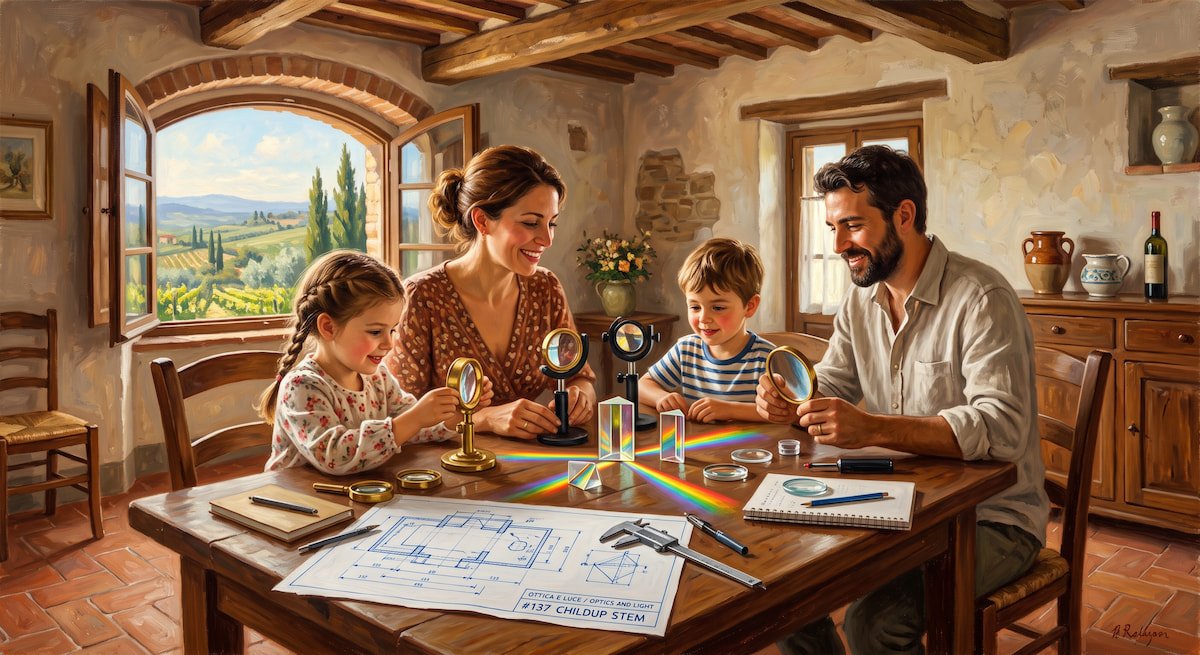
Picture: An Italian family exploring optics and light physics (ChildUp - Gemini)