
China is currently undertaking one of the most comprehensive structural transformations of early childhood education in its history. Long recognized for intense academic competition and rigorous early testing, the nation has fundamentally altered its legal and pedagogical framework. By outlawing premature academic drilling in kindergartens and expanding state-supported inclusive preschools, China is steering early learning away from memorization and toward intentional, high-level logical reasoning and holistic development.
Enshrining early education as a public good
The centerpiece of this transformation is the landmark Preschool Education Law, which formally integrates early childhood education into the national legal framework as a public welfare service. The law establishes a clear legal boundary between preschool and formal primary schooling by explicitly prohibiting "primary school-style" instruction, formal exams, and competitive entry screening for young children.
To equalize opportunities across urban centers and rural regions, the government has invested heavily in affordable, inclusive kindergartens and mandated strict professional standards for educators. The objective is to relieve early systemic pressure while ensuring that every child enters primary school with balanced social-emotional readiness and healthy cognitive curiosity.
Pivoting from rote drills to hands-on STEAM logic
With traditional rote worksheets and repetitive memorization banned from early classrooms, Chinese preschools are embracing experiential, inquiry-based learning models. The emphasis has shifted from "what children memorize" to "how children think."
Early learning centers are increasingly adopting sophisticated STEAM curricula, robotics manipulatives, and spatial-geometric puzzles. Young learners are encouraged to explore cause-and-effect mechanics, structural balance, and algorithmic thinking through hands-on construction rather than passive screen time or abstract formulas. This shift underscores a fundamental truth: complex analytical and mathematical competence is not an innate genetic gift; it is deliberately built when children are given early, consistent opportunities to manipulate logical systems and solve tangible problems.
The home as the true cognitive launchpad
While state reforms have successfully stripped away unhealthy institutional testing in early years settings, Chinese parents remain deeply invested in their children's long-term intellectual development. As classrooms transition toward broader play-based discovery, the family environment becomes the most influential incubator for advanced cognitive skills.
When parents channel their natural educational dedication into joyful, structured cognitive coaching, children progress at remarkable rates. Transforming the home into a collaborative workshop—exploring scientific principles, building intricate mechanical models, and practicing deductive reasoning games together—allows young children to operate years ahead of standard developmental expectations. Real intellectual brilliance is not a roll of the dice; it is the natural, predictable outcome of parents who intentionally nurture their child's logical architecture through daily, affectionate engagement.
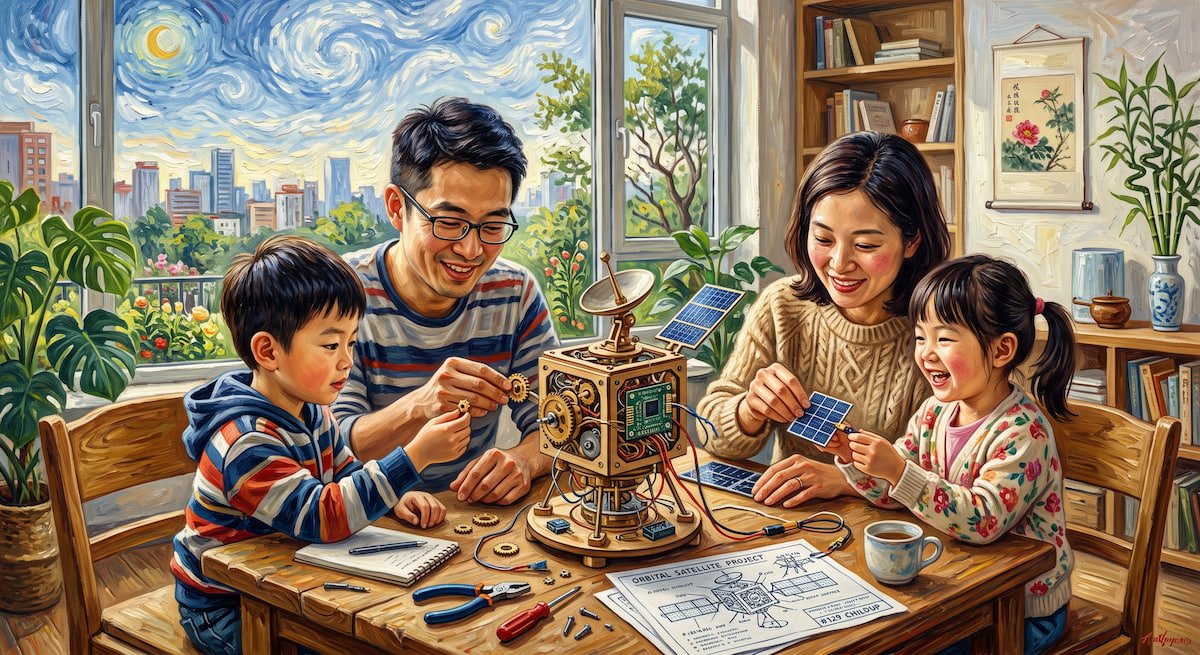
Picture: A Chinese family collaborating on an advanced aerospace and optical mechanics project (ChildUp / Gemini)