
At ChildUp, we live by a simple truth: talent is made, not born. Too often, society clings to the myth that cognitive abilities like memory, IQ, or math capability are completely fixed at birth. In reality, a young child's brain is incredibly flexible and highly malleable—much like clay waiting to be shaped by experience, a supportive environment, and a growth mindset.
Despite its undeniable role in overall academic readiness, structured memory development remains one of the most overlooked skills in early childhood education. Instead of leaving a child's memory capacity to chance, parents and teachers should actively cultivate it from day one.
Turning memory training into a game
When will formal memory training finally be introduced in schools? The most natural way to start this journey is not through rigid, dry drills, but by playing educational games. Because young children naturally love to play, strategic games serve as excellent early learning tools that seamlessly transform disciplined mental effort into a fun and rewarding challenge.
Among these cognitive exercises, mental math stands out as an exceptional workout—perhaps even the king of memory games—for a child's developing working memory.
How to multiply two-digit numbers in your head
Did you know that it is remarkably easy to multiply two-digit numbers entirely in your head without a calculator, pen, or paper? It does not require an innate, magical gift for numbers. Rather, it is simply a matter of breaking a larger problem down into manageable parts and holding those intermediate results in your short-term memory.
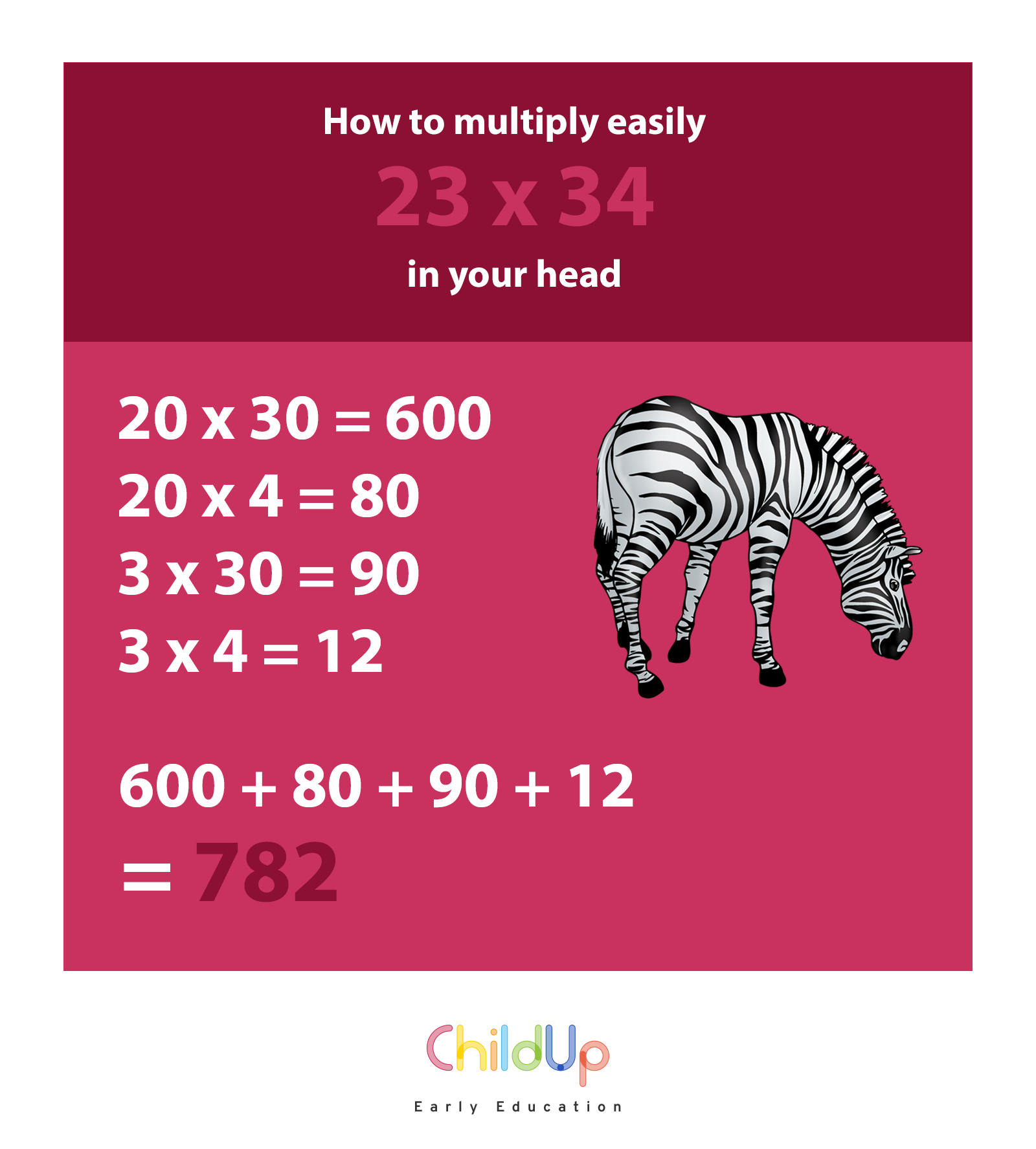
Take a look at the practical strategy illustrated in the ChildUp graphic below: How to multiply easily 23 x 34 in your head
To multiply 23 x 34 mentally, a child learns to separate the tens and the ones, multiply the individual components, and then sum up the results:
- Multiply the tens: 20 x 30 = 600
- Multiply the first tens by the second ones: 20 x 4 = 80
- Multiply the first ones by the second tens: 3 x 30 = 90
- Multiply the ones: 3 x 4 = 12
By holding these four simple pieces in their head, they can easily add them together step-by-step: 600 + 80 + 90 + 12 = 782.
The power of deliberate practice
At first glance, tracking and adding four separate numbers simultaneously might seem daunting for a young learner. However, this is precisely how the architecture of an expert mind is built. What looks like an advanced mathematical feat is actually a highly engaging game of logic, visualization, and concentration.
With regular, deliberate practice, a child's working memory capacity naturally expands. By integrating these types of mental math games into everyday routines, parents and educators act as true brain engineers—helping children build the solid cognitive foundations they need to be completely school-ready and retain a precious learning advantage for life.
Picture: How to multiply easily 23 x 34 in your head (ChildUp.com)