Norway’s early childhood education model stands as one of the world's most progressive and child-centered systems. Operating under the national Barnehage framework, Norwegian early education rejects high-pressure academic drilling and sedentary classroom confinement. Instead, it is anchored in the belief that young children are capable, autonomous individuals with a democratic right to influence their daily lives (barns medvirkning). By combining this deep respect for child agency with an immersive, all-weather outdoor culture, Norway illustrates how physical vitality, natural inquiry, and emotional autonomy construct the underlying cognitive architecture for lifelong academic success.
Democratic agency and radical friluftsliv
At the heart of the Norwegian barnehage is a profound commitment to child-centered democracy. Under national guidelines, educators are mandated to listen to and incorporate children’s views into the daily rhythm of the kindergarten. This practice of medvirkning (co-determination) fosters early articulate communication, collaborative negotiation, and sharp decision-making skills.
This autonomy is exercised primarily outdoors through friluftsliv (open-air life). Regardless of rain, snow, or sub-zero Nordic temperatures, children spend hours outside every day. Norwegian pedagogy actively encourages managed physical risk (risikofylt lek)—climbing trees, navigating rough forest terrain, and learning to handle real woodworking tools under careful supervision. This continuous physical problem-solving builds exceptional vestibular balance, spatial orientation, and self-regulation—critical neurological foundations that protect attention spans and build mental resilience.
Tactile physics and environmental STEM inquiry
Rather than introducing science and mathematics through digital screens or abstract worksheets, Norwegian early learning treats the natural environment as a live laboratory for physical mechanics.
Children explore thermodynamics by experimenting with snow and ice melting rates, examine fluid dynamics along coastal streams, and discover structural balance by building shelters with raw timber and stones. Early mathematical concepts—such as volume, weight, geometric shapes, and spatial measurement—are encountered through direct physical manipulation. By grounding early STEM learning in tangible physical cause-and-effect, Norwegian educators nurture an intuitive, concrete grasp of natural laws that prepares young minds for sophisticated analytical thinking later in life.
The family as the ultimate cognitive laboratory
While Norway’s public barnehager provides an unmatched setting for social democracy, physical confidence, and environmental awareness, group environments are limited by classroom ratios. They cannot offer the intensive, individualized cognitive scaffolding that takes place within the home.
High-level intellectual capability and academic excellence are built within the family. When parents step into the role of primary cognitive mentors—turning everyday mechanics into engaging experiments, exploring spatial and numerical relationships, and engaging in rich, vocabulary-dense dialogue—they accelerate their child's intellectual trajectory far beyond standard developmental milestones. Enduring scholastic talent is never an accidental genetic gift; it is deliberately and thoughtfully constructed by parents who intentionally nurture their child's cognitive foundation through loving, structured mentorship.
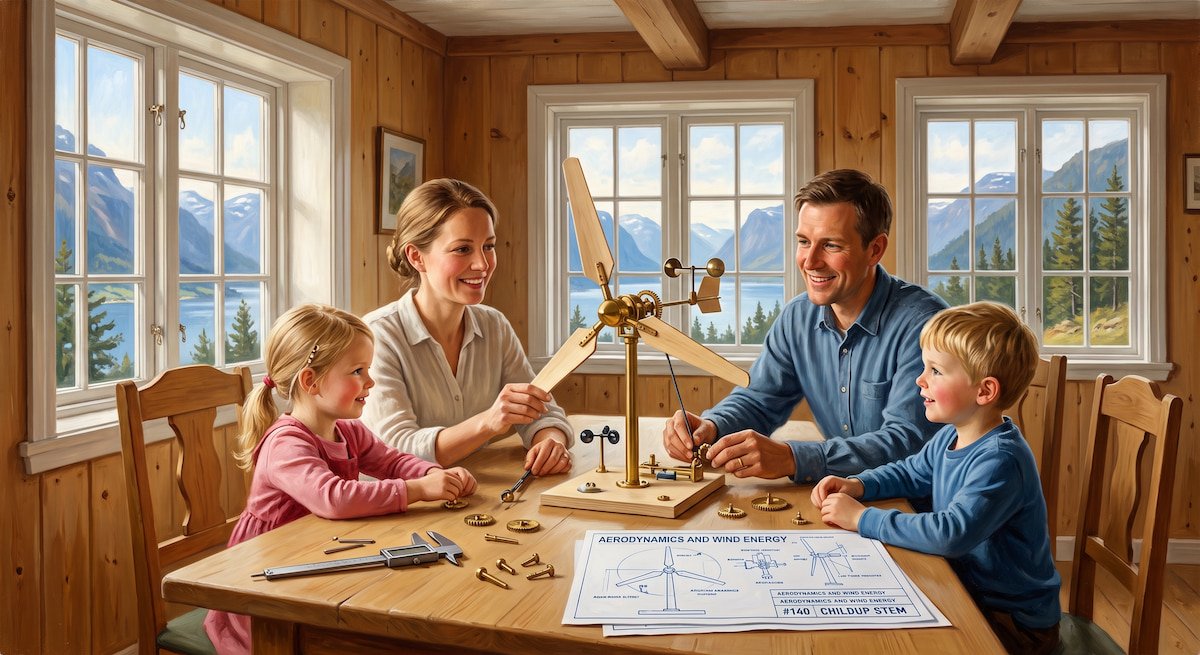
Picture: A Norwegian family exploring aerodynamics and wind energy (ChildUp - Gemini)