As the historic birthplace of Friedrich Froebel’s original Kindergarten, Germany has long championed the principle that early childhood should be an active garden of hands-on discovery rather than a rigid lecture hall. Today, German early childhood education (Frühkindliche Bildung) is evolving dynamically. By pairing its celebrated tradition of outdoor autonomy with nationwide early MINT initiatives (Science, Technology, Engineering, and Mathematics), Germany is demonstrating how tactile problem-solving and structured scientific curiosity build powerful cognitive foundations before formal primary school (Grundschule) begins.
The Froebel heritage and nature-based autonomy
A cornerstone of German early education is the deep respect for child-led exploration and physical independence. From traditional neighborhood Kitas to thousands of dedicated forest kindergartens (Waldkindergärten), young children spend substantial portions of each day outdoors in all weather conditions.
Rather than relying on closed-ended, pre-fabricated toys, German pedagogy emphasizes raw, natural materials and self-directed risk assessment. Children climb, balance, construct, and explore physical boundaries. This environment builds resilient executive function, body-spatial awareness, and emotional self-regulation—critical neurological building blocks that protect attention spans and prepare young minds for rigorous intellectual challenges.
Hands-on MINT inquiry without digital screens
Through nationwide programs supported by initiatives like Stiftung Kinder forschen (Little Scientists Foundation), early childhood centers across Germany are intentionally integrating foundational physics, chemistry, and engineering concepts into everyday routines.
German educators rely on "co-constructive" inquiry—investigating scientific questions alongside children rather than supplying instant answers. Young learners test water flow, explore mechanical balance with levers and pulleys, observe light refraction, and classify natural structures. Crucially, early MINT in Germany remains decisively tactile and screen-free. By grounding mathematical and scientific reasoning in physical cause-and-effect rather than digital apps, children develop deep conceptual intuition, robust spatial logic, and strong fine motor coordination.
The family as the true cognitive workshop
While German Kitas offer an outstanding environment for peer socialization and autonomous exploration, group settings operate under broad ratios that cannot provide the intensive, individualized scaffolding possible at home.
High-level analytical agility and scholastic excellence are forged within the family. When parents embrace their role as primary cognitive mentors—turning household routines into engaging physics experiments, exploring complex spatial puzzles, and nurturing rich linguistic debates—they accelerate their child's intellectual trajectory far beyond standard developmental milestones. Enduring academic capability is never an unpredictable genetic gift; it is the direct result of dedicated parents intentionally constructing their child's cognitive architecture through loving, structured mentorship.
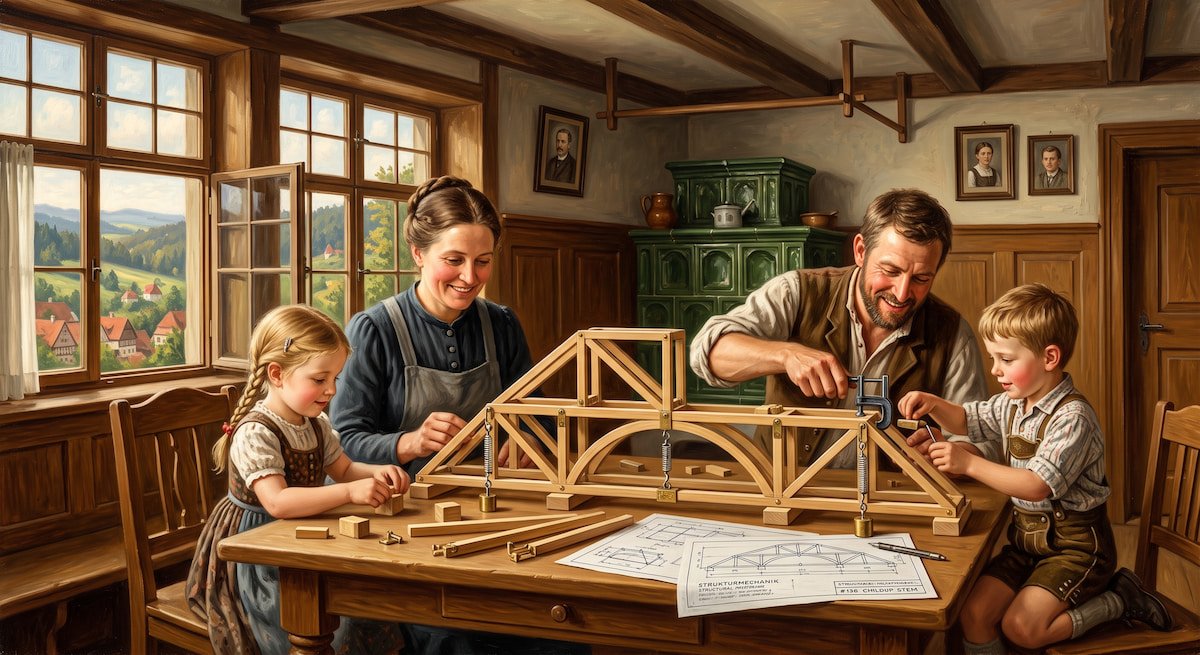
Picture: A German family exploring structural mechanics and bridge engineering (ChildUp - Gemini)