
Time is a highly abstract concept for young children. While they intuitively experience the passing of hours and days, visualizing and measuring time requires significant cognitive leaps. However, by introducing tools like clocks and calendars early on, parents and educators can transform an invisible force into a tangible, interactive learning experience. Grounding time in physical objects perfectly aligns with the belief that early academic support sets a strong foundation for future success.
Making the abstract concrete with analog and digital clocks
Both analog and digital clocks offer unique and complementary educational benefits. While digital displays are ubiquitous in modern life, traditional analog clocks remain one of the most powerful visual aids for young learners.
- Building spatial and fractional awareness: The circular face of an analog clock naturally introduces geometric concepts and fractions, making ideas like "halves" and "quarters" easy to visualize.
- Practicing skip counting: Tracking the minute hand as it moves from number to number serves as a practical, daily exercise in counting by fives.
- Reinforcing number recognition: Digital clocks are excellent tools for helping toddlers and preschoolers quickly identify numerals in their everyday environments.
- Understanding sequencing: Using both types of clocks side-by-side helps children connect the visual, pie-chart representation of an analog clock with the straightforward numerical sequence of a digital display.
Calendars as the daily roadmap for early math and literacy
A calendar is much more than an organizational tool for tracking appointments; it is a rich matrix of patterns, numbers, and vocabulary that supports comprehensive early cognitive development.
- Grasping patterns and cycles: The recurring nature of the seven-day week and the twelve-month year teaches children to recognize, anticipate, and predict patterns.
- Developing foundational math skills: Counting down the days to a birthday, a weekend, or a holiday naturally introduces the concept of subtraction, while tracking the daily date reinforces sequential counting.
- Expanding early vocabulary: Engaging with a calendar introduces essential time-related language, helping children master the crucial differences between concepts like "yesterday," "today," and "tomorrow."
Practical ways to integrate time into everyday learning routines
Embedding time-tracking tools into a daily routine provides the kind of high-touch, consistent learning environment that builds a child’s academic foundation from the ground up.
- Establish a morning routine that involves updating a physical wall calendar, actively noting the day of the week, the specific date, and the current weather.
- Create visual daily schedules that pair analog clock faces with pictures of everyday activities, helping children understand the rhythm and flow of their day.
- Use kitchen timers or sand hourglasses during play and cleanup sessions to give children a concrete, intuitive sense of duration.
Understanding time is a fundamental life skill that seamlessly intersects with mathematics, literacy, and executive function. By intentionally surrounding children with these essential tools, we provide them with the early academic stimulation they need to thrive.
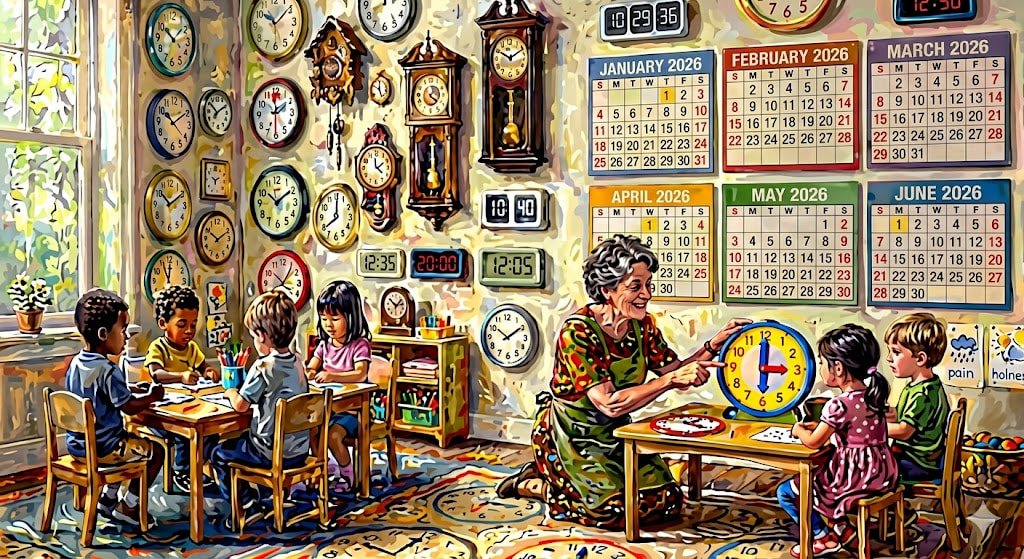
Picture: Decoding the rhythm of time (ChildUp / Gemini)